
You explain your module in the Monday stand-up without thinking twice. Then the quarterly review comes up, the VP joins the Teams call, and the same voice turns slightly shaky. If you’ve ever wondered how to build confidence in public speaking for that second meeting, start here: your knowledge didn’t change between those two rooms. Your track record in that room did.
Confidence follows evidence. You feel sure about things you have already done a few times. A pep talk can’t give you that. Proof can.
So the work is to collect proof, one small speaking moment at a time. Start in rooms where you feel safe, notice the times it went fine, and write them down. Slowly, that record becomes the confidence you carry into the bigger room.
Where does confidence in public speaking come from?
Think of the meetings where you speak easily. The weekly team sync. A call with a vendor you have known for years. You have done them so many times that you already know they end fine.
That is where confidence comes from. Not from being told you are good, but from having done it and seen it go fine.
Research on speaking confidence points the same way. A 2022 study of young people in a presentation programme found that past experience of presenting had the strongest link to how confident they felt. A 2026 doctoral study of international students in college public speaking classes found the same pattern: their confidence grew through practice, feedback and talks that went well, which they took as proof they were getting better.
That last part matters. The talk has to go well, and you have to notice that it went well.
So why haven’t years of meetings already done the job?
By year eight or ten, most professionals have spoken in hundreds of meetings. On paper, that is a lot of proof. It rarely feels that way.
Here is what usually happens. You present the quarterly numbers, and most of it goes smoothly. Then a senior asks a question you weren’t ready for, and you take a few seconds too long to answer. That pause is what you remember on the way home. The other fourteen minutes are gone.
Speakers are often harder on themselves than their listeners are. In one study, people who were anxious about speaking rated their own talks lower than observers rated the same talks.
“Earlier, even in a team meeting, I was hesitating whether to speak or not.”
Akhilesh Bhadouriya, Head of Finance
So the evidence is there. It just isn’t being counted. The good moments slip by, and the one awkward moment gets replayed until it feels like the whole story. That is also why confidence feels uneven: at ease in your team’s stand-up, tense in front of the leadership team. Same skills, same person. The difference is how much counted proof you have in each room.

From our founder
Speak Well, Get Promoted
By Abhishek Gulia, founder of 10,000 Speakers
“Every day, in meetings and boardrooms across India, talented professionals are overlooked, not because they lack ability, but because their ideas remain unheard.”
A guide to confidence, presence and authority for working professionals.
How to be a confident speaker: start in the easier rooms
If confidence comes from proof, the next question is where to get it. Not in the meeting with the VP. Start in a room where things are likely to go fine.
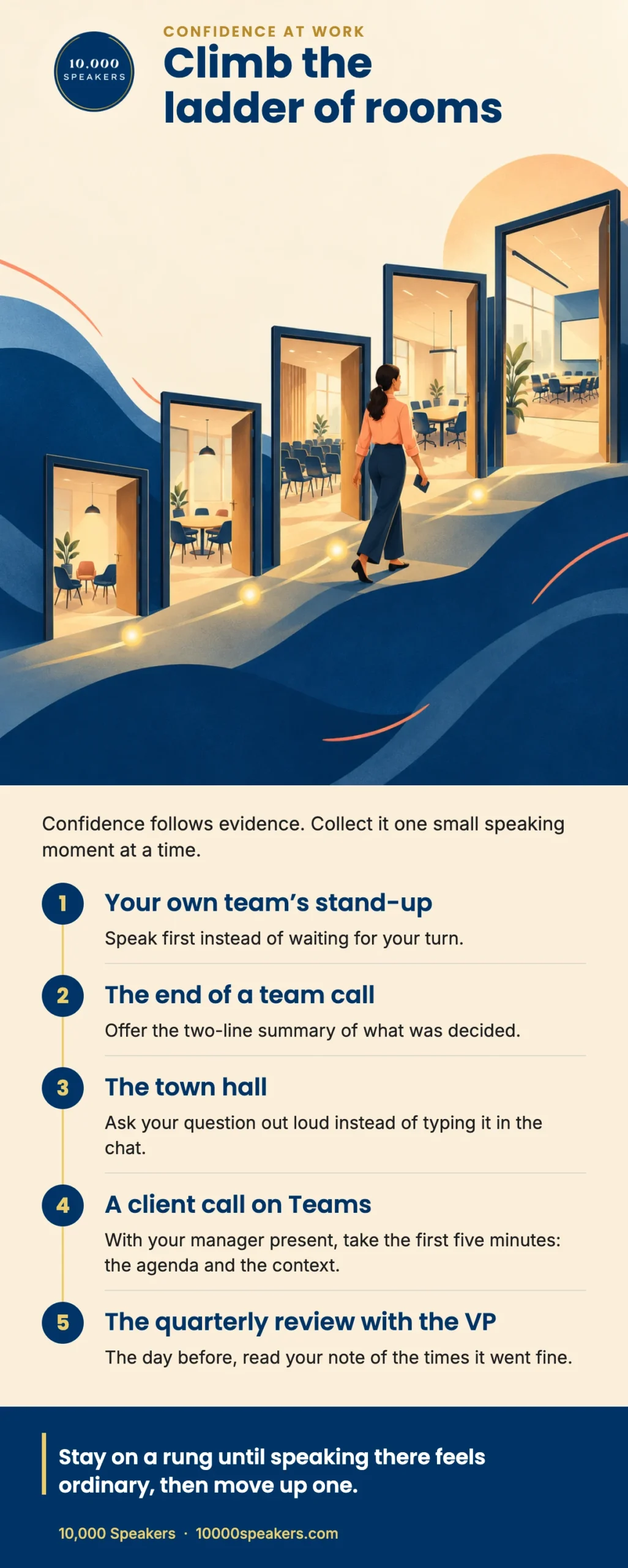
Every workplace has a ladder of rooms like this. The rungs look different for everyone, but they often run something like this:
- Your own team’s stand-up. Speak first instead of waiting for your turn.
- The end of a team call. Offer the two-line summary of what was decided.
- The town hall. Ask your question out loud instead of typing it in the chat.
- A client call on Teams, with your manager present. Take the first five minutes: the agenda and the context.
- The quarterly review with the VP.
You don’t need to climb fast. Stay on a rung until speaking there feels ordinary, then move up one. A small rung, done again, still counts.
Why start low? Because a win in an easy room is still a win. Your own team knows your work and doesn’t pick apart every word, so it’s easier to finish your point and see it land. If you want something specific to try, each of these five books on public speaking gives you one idea you can test in the stand-up first.
How do you keep track of your public speaking confidence?
Collecting proof only works if you actually see it. The mind is quick to forget a smooth meeting and slow to forget a stumble. So it helps to know what “fine” looks like, and to write it down.
Keep the bar realistic. You are not waiting for applause or a message from your manager. If you finished the point you meant to make, it went fine. If someone built on what you said, or you answered a question even after a pause, it went fine. If the discussion moved forward and nobody asked you to repeat yourself, that counts too.
Then keep a note on your phone just for this. After a meeting where you spoke, take two minutes and add a line: the date, the room, what you said, and one sign that it landed. Something like:
14 Nov, client call on Teams, walked them through the revised timeline, client agreed to go ahead.
That’s all. No rating out of ten, no list of what went wrong. Only what went fine. A month in, you’ll have a page of small moments that went well, and with that page in front of you, it gets much harder to believe that one bad pause in a review is the whole story.
How to speak confidently when the stakes go up
Sooner or later, the bigger room arrives. The quarterly review with the VP. A client presentation where the account is on the line. The town hall where you are on the agenda, not in the audience.
This is when the note on your phone earns its place. Open it the day before and read through it. You are not walking in as someone who has never done this. You are walking in with a page of times it went fine.
You may still feel a flutter before you start. That’s normal, even for people who speak often. If it gets in your way, our guide on how to overcome stage fear covers what to do in the moment.
Then bring what worked in the smaller rooms with you. Maybe you always open with one line on why the update matters. Whatever has landed before will likely land again. And after the meeting, add one more line to the note, only this time from the room that used to feel out of reach.
How to build confidence in public speaking: 5 ways to start
- Speak first. Pick a meeting where you feel safe, like your own team’s stand-up, and go before anyone else.
- Move up slowly. Once one room feels easy, try the next one.
- Keep the bar low. If you made your point and the meeting moved on, that’s a win.
- Write it down. One line on your phone, two minutes after the meeting.
- Read it before the big one. The night before the VP review, go through your notes. You’ve done this before, many times.
If you’d like a structured plan to go with this, our guide to improving your public speaking skills has a four-week one, and it gets easier still with regular practice in front of a real room.
Ready to collect your next small win? Join our ₹249 live session.
Frequently asked questions
How long does it take to build public speaking confidence?
There’s no fixed timeline. It depends on how often you speak and how many small wins you collect. If you speak in a few meetings every week and note the ones that go fine, you’ll start to feel the difference sooner than you think.
Why am I confident in team meetings but not in front of seniors?
Because you have more proof in one room than the other. You’ve spoken in team meetings hundreds of times, and to the leadership team far less. The gap closes as you collect a few good moments with seniors, one at a time.
Can an introvert become a confident speaker?
Yes. Confidence comes from having done something a few times, not from being outgoing. Many quiet people speak very well. They just prefer to prepare and pick their moments.
Does practising in front of a mirror build confidence?
It can help you get the words right. But the proof that builds confidence comes from real rooms, with real people listening. Use the mirror to prepare, then use the stand-up to prove it.
Is being confident the same as not feeling nervous?
No. Confident speakers can still feel nervous before a big meeting. The difference is that they know they’ve handled rooms like this before.
References
Flores-Molina, D. M. M. (2026). Gaining voice, creating opportunity: An exploration of non-native English-speaking students’ sources of self-efficacy in U.S. college public speaking classrooms [Doctoral dissertation, University of Central Florida]. STARS. https://stars.library.ucf.edu/gradstudies_etd_2026/266
Gallego, A., McHugh, L., Penttonen, M., & Lappalainen, R. (2022). Measuring public speaking anxiety: Self-report, behavioral, and physiological. Behavior Modification, 46(4), 782–798. https://doi.org/10.1177/0145445521994308
Marshall-Wheeler, N., Meng, Y., & Worker, S. (2022). Exploring public speaking self-efficacy in the 4-H presentation program. Journal of Extension, 60(4), Article 12. https://doi.org/10.34068/joe.60.04.12