

“Um… uh, so I actually just want to talk about, uh, the review.” The quarterly review hasn’t even started, and the room is already waiting through the ums and uhs for a sentence that should have taken three seconds. Those little sounds are filler words, and almost all of us use them.
So what are filler words? They’re the small sounds and words we drop into speech that don’t add any meaning: “um”, “uh”, “so”, “like”, “you know”. In Indian offices you’ll hear a few more: “basically”, “actually”, “na”, and the “right?” at the end of a sentence.
Why do we use them? Because you are often speaking faster than you are thinking. You’ve started the sentence, the next idea hasn’t arrived yet, and the filler holds your place while you think.
That’s why filler words aren’t a grammar problem. Your English is fine. A few fillers are normal, too. The goal is fewer, not zero.
What exactly is a filler word?
A filler word is anything you say just to fill a gap while your mind catches up. Fillers usually come in three kinds:
- Sounds: “um”, “uh”, “hmm”
- Single words: “so”, “basically”, “actually”, “like”
- Short phrases: “you know”, “I mean”, “kind of”
The tricky part is that the same word can be a filler in one sentence and not in the next. “We missed the deadline, so we’re moving the launch” uses “so” to give a reason. “So… the numbers this quarter…” uses it only to buy time.
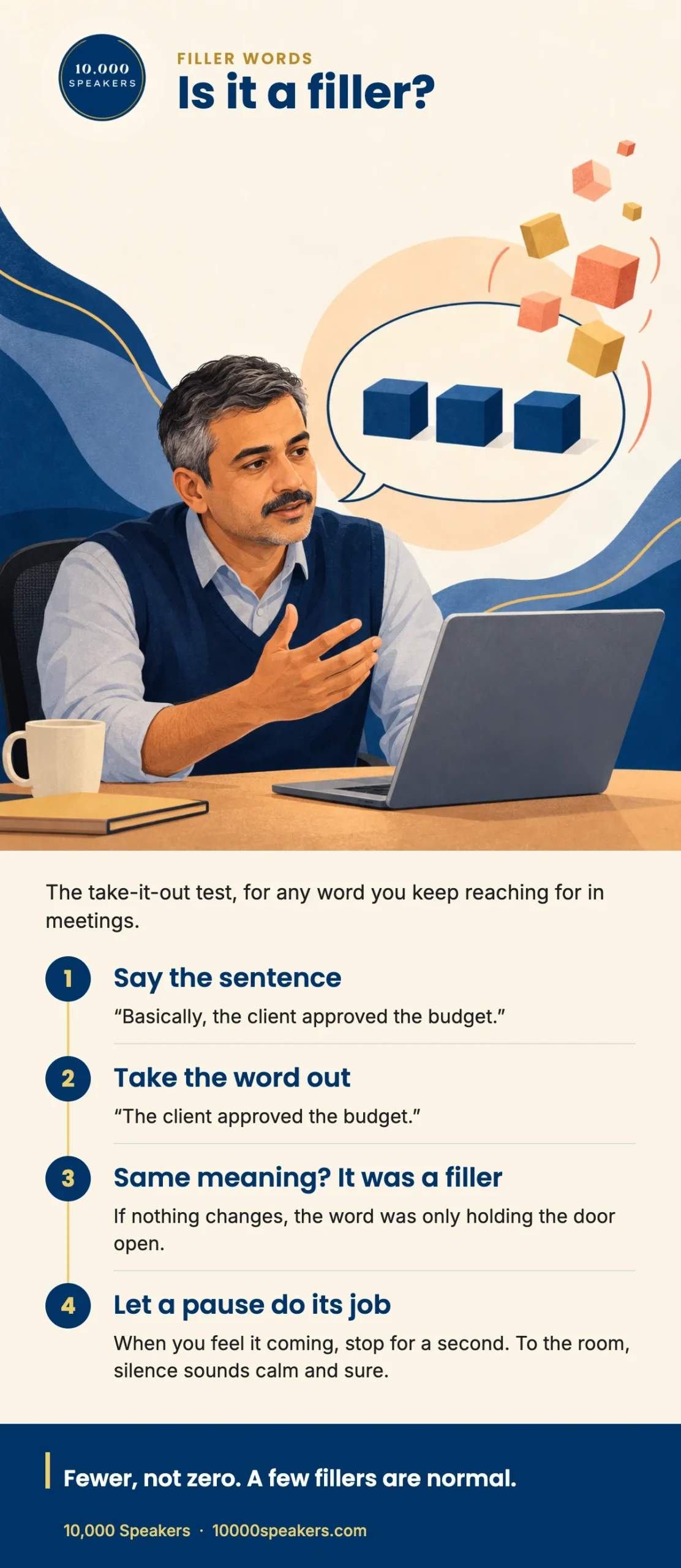
So how do you know when it’s a filler? There’s a simple test. Take the word out and read the sentence again. If it means the same thing, the word was a filler. “Basically, the client approved the budget” says exactly what “The client approved the budget” says. The “basically” was only holding the door open.
Why do we use filler words?
Because speaking and thinking don’t always move at the same speed.
Every time you talk, you’re doing two jobs at once. You’re working out what to say next, and you’re saying what you’ve already worked out. Most of the time the two keep pace. Then a question comes from an angle you didn’t expect, or you reach the part of your update you didn’t plan, and your mouth gets there before your thoughts do. The words have started, but the next idea isn’t ready. So “umm” fills the gap.
Fillers aren’t random noise, though. Psychologists Herbert Clark and Jean Fox Tree studied recordings of real conversations and found that people tend to say “uh” before a short delay and “um” before a longer one (Cognition, 2002). In effect, the filler tells the listener, “Hold on, I’m not done.”
That’s also why fillers pile up on calls. On Teams, a few seconds of silence can feel like an opening for someone else to unmute. So you keep talking with “basically” and “so” until the actual point shows up.
Habit plays a part too. Say “actually” in enough stand-ups and you stop choosing it. It simply comes out, every time you talk.
Picture a quarterly review. Your VP asks why one account dipped. You know the answer, but you came ready to talk about the other three. What comes out first is “So… uh, basically…” while your mind goes looking for the right file. Answering on the spot like this is its own skill, and our guide to impromptu speaking covers how to give your thoughts a quick shape before you start.
None of this means your English is weak. It means you started speaking before you had finished thinking.
Are filler words always bad?
Not exactly. Everyone uses filler words. Your sharpest manager does. So does the VP who seems to speak in finished paragraphs. In everyday conversation, a few of them go by and nobody notices.
Some research even suggests they can help. Scott Fraundorf, a psychology researcher who studies how listeners remember what they hear, has said that a few fillers, but not too many, can make a story easier to follow. Too many make it harder. What matters is how many you use.
And that’s where the trouble starts. The moments that matter most at work are often exactly where fillers pile up. You’re presenting quarterly numbers to a VP, and every slide starts with “So, basically…” and ends with “right?”. The work is solid and the numbers are good. But the point is buried under all those small words, and what the room remembers is that you sounded unsure.
That’s the real cost. The problem isn’t that you used a filler. It’s that there were enough of them to get between you and your point.

From our founder
Speak Well, Get Promoted
By Abhishek Gulia, founder of 10,000 Speakers
“Every day, in meetings and boardrooms across India, talented professionals are overlooked, not because they lack ability, but because their ideas remain unheard.”
A guide to confidence, presence and authority for working professionals.
How do you start cutting down on filler words?
First, find out which filler is yours. Most people lean on one or two, and you can’t drop a habit you haven’t spotted. Listen back to a recording of your next Teams call once, and your favourite will turn up again and again. Then, when you feel it coming, let a short pause do its job instead. To the room, a second of silence sounds calm and sure. For the full method, from spotting your filler to a five-minute daily drill, see our guide on how to stop using filler words.
“I didn’t forget what I had to say. I didn’t fumble.”
Nitin Yadav, e-commerce, whose filler was “you know”, one he hadn’t noticed until he heard himself speak
Remember that opening line? “Um… uh, so I actually just want to talk about, uh, the review.” Nothing in it was wrong. The person knew what they wanted to say. Their mouth simply started before their thoughts were ready. The people who sound sure of themselves in a quarterly review haven’t got rid of every filler. They’ve learned to let a pause carry the moment, and you can practise that pause in our guide to voice modulation. It gets easier still with regular practice in front of a real room.
Want to practise this live, with real feedback? Join our ₹249 live session.
Frequently asked questions
What are some examples of filler words?
The most common ones are “um”, “uh”, “so”, “like”, “you know” and “I mean”. In Indian offices, you’ll also hear “basically”, “actually”, “na” and a “right?” at the end of a sentence. Most people lean on just one or two of these.
Is “OK” a filler word?
Sometimes. “OK, let’s move to the budget” uses it to mark a shift, and that’s a real job. But “OK, so, OK, the timeline is…” uses it to fill a gap. Apply the same test: take it out, and if nothing changes, it was a filler.
Why should you avoid filler words?
You don’t need to avoid them completely. The trouble comes when there are so many that they bury your point. In a client call or a review with seniors, a steady stream of fillers can make solid work sound less certain than it really is.
Why do I use filler words even when I know the topic well?
Knowing the topic and having the words ready are two different things. When a VP asks about your project from an angle you didn’t expect, your mind has to rearrange what you know before you can answer, and fillers fill that gap. It doesn’t mean you’re unprepared. It means you’re working out your answer while you speak.
Are filler words okay in a presentation to seniors?
A few are fine. Nobody expects you to speak like a newsreader. But a presentation gives you something an unplanned question doesn’t: time to prepare. If you know your opening line and your main points well, there are fewer gaps for fillers to fill. Our guide on how to start a speech helps with that first line.
References
Baral, S. (2016, July 26). Can’t quit saying ‘um’ and ‘ah’? Just learn how to use them better. Government Executive (first published by Quartz). https://www.govexec.com/management/2016/07/cant-quit-saying-um-and-ah-just-learn-how-use-them-better/130216/
Clark, H. H., & Fox Tree, J. E. (2002). Using uh and um in spontaneous speaking. Cognition, 84(1), 73–111. https://doi.org/10.1016/S0010-0277(02)00017-3