You’ve just presented the last slide of your quarterly review. You say, “That’s all from my side, any questions?” Someone asks about one number on slide four, the conversation drifts, and the call ends without the approval you came in for. Most of that comes down to knowing how to end a speech.
So how do you end a speech or a presentation at work? Close with three things: one line that sums up your main point, a clear ask, and the next step with a date. Then stop. Plan that last line word for word before the meeting, so it comes out exactly the way you mean it.
The ending matters more than it seems. A clear close gets you a decision. A vague one leaves the matter hanging for another week, and another meeting.
Why does the end stay longer with people?
Think about the last quarterly review you sat through. You probably can’t recall what was on slide six. But you likely remember how it ended: whether the presenter walked out with a yes, or whether everyone left unsure of what had been agreed.
That’s how memory tends to work. When we look back on an experience, we don’t give every minute equal weight. We lean on the most intense moment and on the final one. Psychologists call this the peak-end effect. In one 2019 study, people who watched a horror clip that stopped at its scariest moment later rated the whole clip as more frightening than people who watched the same clip with a calmer ending.
For a work presentation, this means your last minute carries extra weight. The room may sit through twenty minutes of numbers and updates, but the close is what they walk out with. It’s the line your manager repeats when their own boss asks, “So what does the team need?”
That’s why the ending deserves as much planning as your slides.
What should you say instead of “That’s all from my side, any questions?”
“That’s all from my side” tells the room you’ve finished talking. It doesn’t tell them what you need from them. So the conversation drifts to whatever is on someone’s mind, and your main point slips away with it.
A stronger close does three things, in this order.
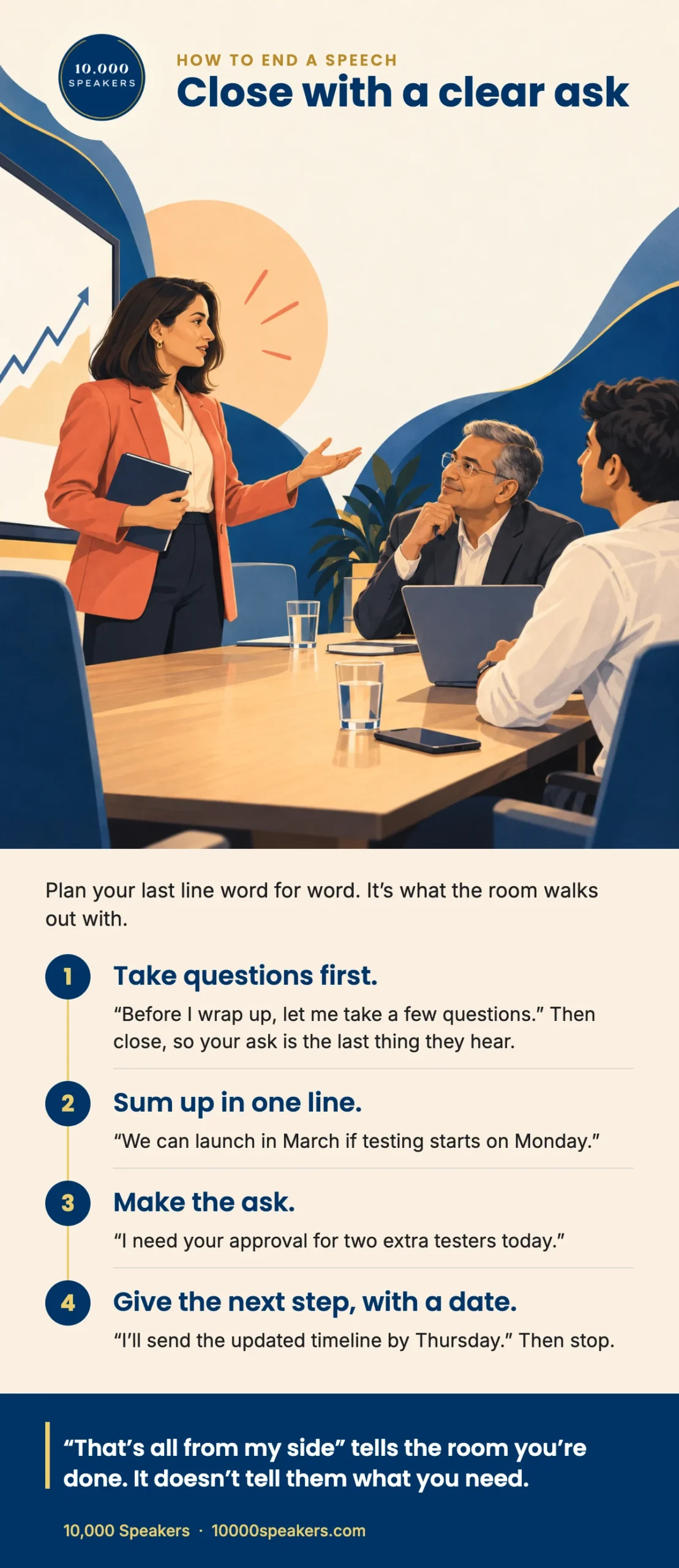
First, sum up your point in one line. Not a recap of every slide, just the one thing you want people to carry out of the room. “We’re on track for the March launch, as long as testing starts next week.”
Second, make the ask. Say clearly what you need: an approval, a choice between two options, or a name against a task.
Third, give the next step, with a date. “Once we have the go-ahead, I’ll share the revised plan by Thursday.” This is what turns a discussion into action.
Put together, it sounds like this:
Instead of: “That’s all from my side, any questions?”
Try: “So, in short, we can launch in March if testing starts on Monday. I need your approval for two extra testers today. Once that’s done, I’ll send the updated timeline by Thursday.”
It takes less than twenty seconds, and it gives the room something specific to say yes to. You can still take questions. The trick is to take them before this final close, not after it. More on that below.
“While explaining to clients or investors I would lose some of the points, and that really made me lose on some deals.”
Pranita Kohli, founder, financial services
What is a good closing remark in different situations?
The three-part close works almost anywhere. What changes is the size of the ask and how much time you have.
The Monday stand-up
You have a minute, maybe less, so end on the one thing the team can help with. “That’s my update. The only blocker is API access from the client’s side. If anyone has a contact in their IT team, please ping me after this call.”
A quarterly review
The room wants to know what happens next quarter, not just what happened in the last one. “We closed the quarter just short of target, mainly because of the delay in the Pune rollout. For next quarter, I’m asking for one more person on the support team so it doesn’t repeat. If that works, I’ll share the hiring request by Friday.”
A client call on Teams
On a call, people start dropping off the moment it feels over. So close with what each side does next. “To sum up, we’re going ahead with option B. Could you confirm the go-live date by Wednesday? From our side, we’ll mail you the test plan today so everything is in writing.”
Presenting to a VP
Senior leaders often get less time with you than the calendar invite says. So put the decision right at the front of your close. “The decision I need from you is whether we pilot this in two cities or wait for the full budget. I’d recommend the pilot. If you agree, we can start next month.”
You can still thank people, of course. Just let the ask or the next step be the last thing they hear.
What do you do when the Q&A keeps going?
You’ve made your point, opened the floor, and the questions keep coming. One of them leads to a side discussion about another project. Ten minutes later, someone says, “We’re over time,” and the call ends. Your ask never got made.
The simplest fix is to change the order. Take questions just before your close instead of at the very end. You might say, “Before I wrap up, let me take a few questions.” Once they’re done, you give your final summary, your ask and your next step. That way, the last thing people hear is what you need from them, not the tenth question.
If time starts running short, step in politely. “I’m conscious of time, so let me take one last question.” Most people are grateful when someone keeps a meeting on track.
Some questions will need more time than the meeting allows. Give each one an owner and a time. “That’s a fair point on the vendor costs. I’ll check with finance and mail everyone by tomorrow.” The person feels heard, and the meeting moves on. For the questions you can answer then and there, keep it short: your answer, one reason and the next step. Our guide to impromptu speaking shows how.
Then come back to your close, even if you have only thirty seconds left. “Just to close, the one thing I need today is your approval on the two extra testers. I’ll send the updated timeline by Thursday.” It takes a little nerve to do this when people are reaching for their laptops. But it’s often the moment that decides whether you leave with a yes.
How to end a speech at a town hall or team event
Not every talk needs a decision. At a town hall, a team celebration or a farewell, the goal is for people to leave with one clear thought.
So come back to the one idea you started with. If you opened with the team’s biggest win of the year, end there too. Thank people briefly and by what they did, not with a long list of names. “This launch happened because the support team stayed late for three weeks. Thank you.”
Then end on a short line that’s easy to repeat. “Next year, let’s make this our starting point, not our best.” Say it, pause, and stop. A strong last line of a speech doesn’t need anything after it.
Before your next presentation
That’s how to conclude a speech at work: sum up in one line, make a clear ask, and name the next step. It gets easier with regular practice in front of a real room. And once your close is ready, our guide on how to start a speech will help you get the room listening from the very first line.
Want to practise your closing with real feedback? Join our ₹249 live session.
Frequently asked questions
What is a good way to end a speech?
End with a one-line summary of your main point, followed by a clear ask or next step.
What should I say at the end of a presentation?
Say what you want the room to remember, what you need from them, and what happens next. For example: “In short, we can launch in March. I need your approval today, and I’ll share the plan by Thursday.”
How long should the closing of a presentation be?
Usually under a minute. In a short stand-up, two or three sentences are enough. Signal it with a simple “To close” or “Just to sum up”, so your last line feels planned rather than sudden.
How do I end a presentation if no one asks any questions?
Silence often just means people are thinking. Go straight to your close: sum up, make your ask and give the next step. You can add, “If anything comes up later, feel free to mail me.”
How do I end a presentation on a Teams or Zoom call?
On a call, people start leaving the moment it feels over. So keep your close short, say the next step out loud, and follow it up in the chat or on email so everyone has it in writing.
References
Müller, U. W. D., Witteman, C. L. M., Spijker, J., & Alpers, G. W. (2019). All’s bad that ends bad: There is a peak-end memory bias in anxiety. Frontiers in Psychology, 10, Article 1272. https://doi.org/10.3389/fpsyg.2019.01272