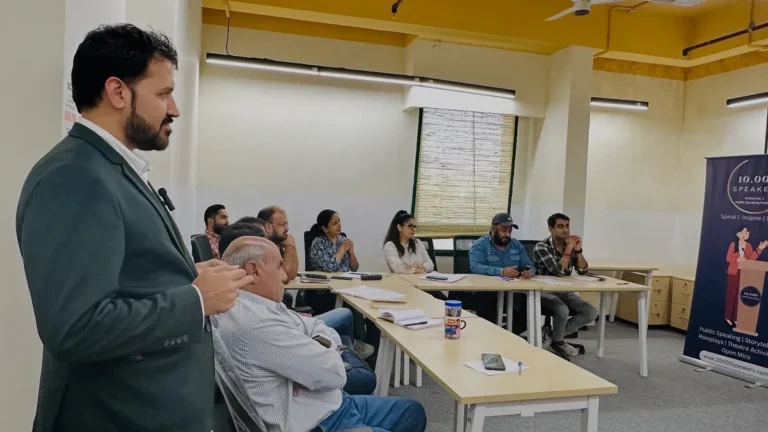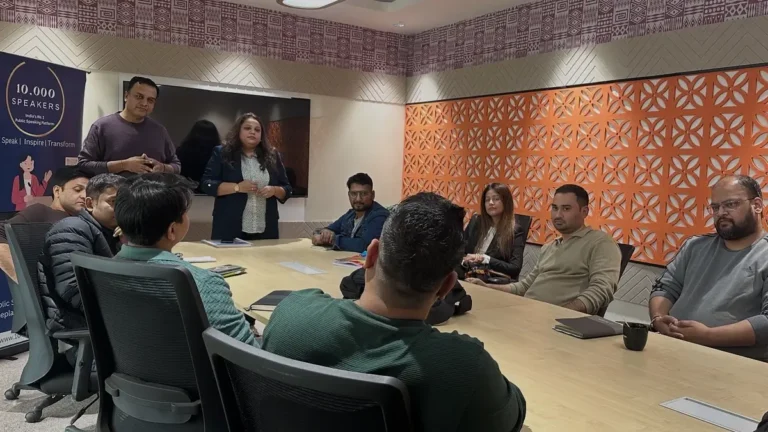

You unmute on the Teams call and begin: “Good morning everyone, today I am going to talk about the Q3 numbers.” By your second slide, three cameras are off and someone is clearly typing a reply to an email. Most of that comes down to knowing how to start a speech.
This happens in offices every single day, and it has very little to do with the quality of the work you’re about to share. It has everything to do with the first 30 seconds.
So how do you start a speech at work? Skip the build-up. Greet the room in one short line, then say the thing they most need to hear: the result, the problem or the decision. After that, tell them what you need from them. When people know in the first few seconds why your update matters to them, they stay with you for the rest of it.
Why do the first 30 seconds matter?
People often join your meeting straight from another one, their mind still on the last call or the client escalation. Microsoft’s Human Factors Lab asked people to wear EEG caps through a run of video meetings. When the calls were back to back with no breaks, stress kept building from one meeting to the next, and their brains showed signs of lower focus and engagement. So the room you’re speaking to is often tired before you say a word.
Then there’s the inbox. A large study of Microsoft employees found that about 30% of remote meetings had people sending or replying to emails during the call. It happened more in longer meetings, bigger meetings and recurring ones, like the weekly team sync. One of the reasons people gave was simple: the topic didn’t seem to concern them.
That’s where your opening comes in. In the first 30 seconds, you’re not up against a better speaker. You’re up against their inbox. Show them early why this matters to them, and you give them a reason to stay.
How should you greet the room?
A long greeting uses up those 30 seconds. Keep it to one line, then go straight to your point. The greeting opens the door. Your next sentence is what brings people in.
Then run straight into your first point, with no filler in between.
That could be a result: “Thanks for joining. We closed the migration two days early.”
It could be a decision you need: “Thanks for making the time. I need your sign-off on the revised budget before Friday.”
Or it could be something that affects everyone listening: “Good to see everyone here. The new leave policy starts next month, and here’s what changes for you.”
Two small habits help too. Do your “Can everyone see my screen?” check a minute before the meeting begins, so it isn’t your first line. And share the agenda after your opening, not before it. Once people know why they should listen, they’re happy to hear how you’ll get there.
What is the best sentence to start a speech?
The best opening sentence is the one your audience would want to hear first if they could skip everything else. At work, that usually comes in one of three forms.
The first is a result or a number, as long as it’s a number the room cares about. “We cut client onboarding from ten days to six” lands in a few seconds and leaves people wanting the rest.
The second is a question. Not a quiz, but a real question the room would like answered, such as “Why did two of our biggest accounts renew early this year?” In a review of brain research, Gruber and Ranganath (2019) explain that when we feel curious, the brain’s reward system becomes more active, which helps us focus on and remember what comes next. Your question opens a gap, and the rest of your talk fills it.
The third is the decision or the problem. When you need something from the room, say so upfront: “We have to choose between two vendors by Friday, and I’d like us to decide today.” People like knowing what’s being asked of them before they hear the detail.
You’ll notice what’s missing here: jokes, famous quotes and “Imagine a world where…” These can work on a stage. In a Tuesday review, they mostly delay the point.
How do you start a presentation at work?
Start with what this particular room needs from you. A stand-up, a client call and a review with your VP each want something different, so your opening changes with them.
The Monday stand-up or team update
Your team wants to know two things: where things stand and whether anything is stuck. Lead with that rather than a recap of everything you did last week.
Instead of: “So last week I worked on a few things, let me go one by one…”
Try: “The payment module is on track for Thursday. One blocker: we’re still waiting on access from the client’s IT team.”
A client presentation on Teams
Clients join to hear about their problem, not your company. Start with their goal and show them you’ve understood it. The company slide can come later.
Instead of: “Let me start with a quick introduction to our company and our team.”
Try: “You mentioned your support costs went up this year. In the next 15 minutes, we’ll show you three ways to bring them down.”
A review with seniors or a VP
Senior leaders usually walk in with little time and a lot on their minds. Give them the headline and your ask first, then the detail. If they want more, they’ll ask.
Instead of: “To give some background, we started this project in April…”
Try: “We’re two weeks behind on the rollout. I need one more developer to recover the time, and here’s why.”
And when a senior turns to you mid-meeting with no warning at all, our guide to impromptu speaking gives you a three-part answer you can use on the spot.
“Earlier, even in a team meeting, I was hesitating whether to speak or not.”
Akhilesh Bhadouriya, head of finance
A town hall
A town hall is a mixed room, with different teams, levels and concerns. Open with something everyone there shares, like a company-wide number, a win, or a change that affects all of them.
Instead of: “Good afternoon, everyone. Today I’ll be covering a few updates from leadership.”
Try: “Together, we crossed 1,000 customers this quarter. Here’s what that means for the year ahead.”

How to start a speech in English if you think in another language
Plenty of people plan their update in Hindi, Tamil or Marathi in their head, then switch to English the moment they unmute. The switch takes a second, and the opening is where you feel it most.
The fix is simple: write your first two lines word for word and say them out loud a few times before the meeting. Just the opening, not the whole talk. Once those first lines come out smoothly, you settle into your rhythm and the rest follows far more easily.
Keep those lines short, too. “Here’s where we stand” or “Quick update on the rollout” sounds clear and sure of itself.
A steady opening also helps when your nerves are high. If those first few seconds feel the hardest, our guide on how to overcome stage fear shows you how to speak well with the nerves still there.
Before your next meeting
The room decides in the first 30 seconds whether to listen or open their inbox. Greet them in a line, give them the point, and they’ll stay with you for the details. Openings get easier with regular practice in front of a real room. And once the room is listening, the close is what they remember, which we cover in how to end a speech.
Want to practise your opening with real feedback? Join our ₹249 live session.
Frequently asked questions
What is a good opening statement for a speech?
A good opening statement tells the room why they should listen. At work, that’s usually a result, a real question or a decision you need. For example: “Our renewal rate is the highest it’s been in three years, and two changes made the difference.”
How do you greet people in a formal speech or presentation?
Keep it simple. “Good morning, everyone” works even in a formal room with senior leaders present. If someone has introduced you, a quick thank-you to them is a nice touch. Then move straight to your point.
Should I introduce myself at the start of a work presentation?
Only if the room doesn’t already know you. For a client or a cross-team audience, one line is enough: “I lead delivery on your account, so I’ll walk you through the plan.” Your own team can skip this entirely.
Is it okay to open with humour?
At work, it’s usually safer not to. If light humour comes naturally to you and you know the room well, let it come after your opening rather than in place of it.
How long should the opening of a presentation be?
Two or three sentences, roughly your first 30 seconds. By then, the room should know what you’re talking about and why it matters to them.
References
Cao, H., Lee, C.-J., Iqbal, S., Czerwinski, M., Wong, P. N. Y., Rintel, S., Hecht, B., Teevan, J., & Yang, L. (2021). Large scale analysis of multitasking behavior during remote meetings. In Proceedings of the 2021 CHI Conference on Human Factors in Computing Systems. Association for Computing Machinery. https://doi.org/10.1145/3411764.3445243
Gruber, M. J., & Ranganath, C. (2019). How curiosity enhances hippocampus-dependent memory: The prediction, appraisal, curiosity, and exploration (PACE) framework. Trends in Cognitive Sciences, 23(12), 1014-1025. https://doi.org/10.1016/j.tics.2019.10.003
Microsoft WorkLab. (2021, April 20). Research proves your brain needs breaks. Microsoft. https://www.microsoft.com/en-us/worklab/work-trend-index/brain-research