It’s the quarterly review. The numbers are on the screen, the discussion is moving along, and then the VP turns to you. “Can you quickly update everyone on where we are?” No slides. No notes. Just a room waiting to hear from you. That moment is impromptu speaking.
It means speaking without preparation, when someone asks for your view or an update and you have a few seconds to respond. At work, this happens far more often than any planned presentation: the Monday stand-up, the review with seniors, the client call that drifts off the agenda. Nobody sends a calendar invite for these moments, yet they shape how colleagues see you.
Handling them well doesn’t need a quick tongue. It needs a simple shape to follow. Take a breath, give your answer first, back it with one reason, and end with the next step. Three parts, and the room hears someone who knows their work.
What does impromptu speaking mean at work?
An impromptu talk is anything you say when you didn’t know you’d be asked to speak. You get the question, and you answer then and there.
Most guides explain this through contests, where someone picks a topic out of a bowl. At work, it looks much more ordinary.
The stand-up. A colleague is on leave, and your manager says, “Can you give their update too?” You know roughly what they were working on, but you hadn’t planned to speak about it.
The quarterly review. A senior looks at a dashboard and asks, “Why did this number dip in August?” It isn’t on your slide, but it’s your area, so all eyes come to you.
The client call on Teams. Halfway through, the client asks, “Can we add one more feature before launch?” It’s not on the agenda, and they want a view now, not after the call.
Each of these is an impromptu speech. It might last thirty seconds, but it carries weight. The person asking is often a senior or a client, and what you say in that moment tends to stay with them longer than the deck you spent a week on.
“Earlier, even in a team meeting, I was hesitating whether to speak or not.”
Akhilesh Bhadouriya, head of finance
Why does your mind go blank when you’re suddenly asked something?
You know the answer. You’ve worked on this project for months. But the moment the VP looks at you and says, “What’s your view?”, the words seem to scatter.
There’s a simple reason for this, and it has nothing to do with how well you know your work. Being asked to speak on the spot, in front of people who judge your work, is one of the most dependable ways to set off the body’s stress response. Researchers use almost this exact situation in the lab. In the Trier Social Stress Test, people are asked to speak in front of an evaluating panel with very little time to prepare, and a 2022 review of studies using this test found that it reliably raises cortisol, the body’s main stress hormone.
That stress affects how we think in the moment. A 2025 analysis of 42 studies found that acute stress made people less accurate on tasks where they had to hold information in mind while also updating it. That’s exactly what answering a senior asks of you. You hold the question, recall the facts and shape a reply, all at once.
This is why a structure helps so much. When your mind already knows the shape of the answer, it has fewer things to juggle. You only need to fill in the blanks. And if the freeze itself is what worries you, our guide on how to overcome stage fear covers what to do in the moment your mind goes blank.
What is a quick structure for impromptu speaking?
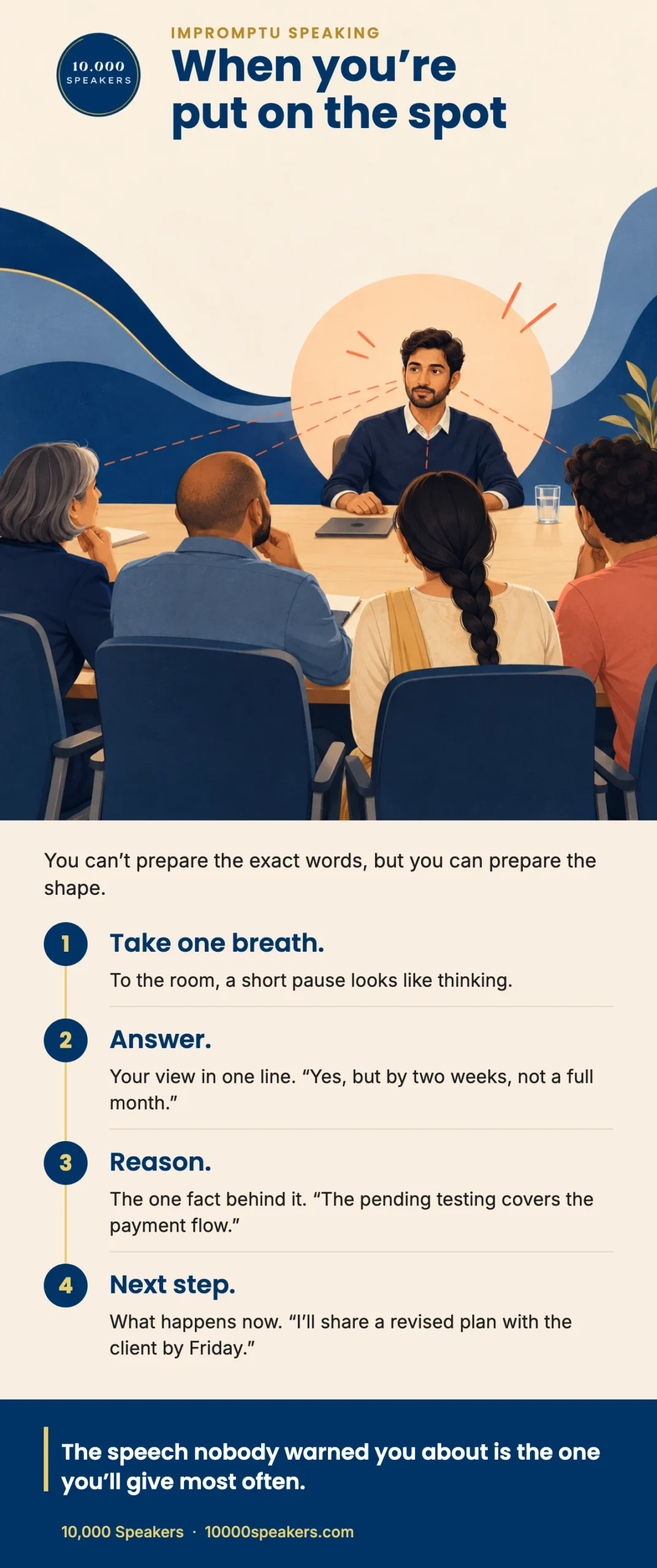
When a senior suddenly asks for your view, you need only three parts: Answer, Reason, Next step.
Answer. Your view in one line. Say it first, so they know where you stand.
Reason. The one fact behind your view. Just one. If they want more, they’ll ask.
Next step. What you suggest happens now. It turns your view into action and gives you a clean way to stop. It’s the same shape as a strong close to a presentation, just shorter. Matt Abrahams teaches a similar three-part shape, What? So what? Now what?, in Think Faster, Talk Smarter, one of our best books for public speaking.
Before you begin, take one breath. To the room, a short pause looks like thinking.
An impromptu speaking example
In a quarterly review, the VP asks, “Should we push the release to next month?”
Answer: “Yes, but by two weeks, not a full month.”
Reason: “The pending testing covers the payment flow, which caused most client complaints last time.”
Next step: “If we move it to the 15th, I’ll share a revised plan with the client by Friday.”
Three sentences, about twenty seconds. The VP gets a clear view, a reason to weigh and a date to hold you to.
The same shape works for “Can you quickly update everyone?” Say where things stand, the one thing that matters most, and what happens next. It works for the same reason a good opening at work does: the point comes first.
How do you answer questions on the spot when you don’t know the full answer?
Sometimes the question lands outside what you know. A client on Teams asks for a cost figure you haven’t seen yet, or a senior asks about a team you don’t manage. Guessing can feel safer in the moment, but a wrong number said with confidence is hard to take back.
A better way is to share what you do know, say plainly what you’ll confirm, and give a time. Something like, “The design work is done and development starts next week. I don’t have the final cost with me, so I’ll check with finance and send it to you by 4 today.” It sounds calm and in control, and people remember the colleague who came back on time with the right number.
If you simply need a few seconds to think, it’s fine to say so. “Good question, give me a second” works well. So does repeating the question back: “So you’re asking whether we can manage this within the current budget?” It buys you a moment and checks that you’ve understood. There’s no need to fill the gap with “um” or “basically”. A short silence while you gather your thoughts comes across as care, not panic.
How do you get better at impromptu speaking?
Impromptu speaking sounds like something you can’t prepare for, but most of it can be. You may not know the exact question, but you usually know the topics that could come up. Before any meeting, take two minutes to think of a one-line update for each project you’re working on. Where does it stand, and what’s the one thing that matters right now? If someone turns to you, the answer is already half ready.
The structure also gets easier the more you use it. Try Answer, Reason, Next step on small, everyday questions. When a colleague asks which vendor you’d go with, or a friend asks where to eat on the weekend, give your view, one reason and a suggestion. After a while, it stops feeling like a method and starts sounding like you. Our guide to improving your public speaking skills has a four-week plan built the same way.
One more habit helps: record a short voice note on your phone. Pick one work question a day, such as “Why is this project worth the budget?”, and answer it in under a minute. Listen back once. You’ll quickly notice where you went round in circles and where you were clear. If it’s your pace or tone that bothers you, our voice modulation guide has a 10-minute exercise.
Before your next meeting
The speech nobody warned you about is the one you’ll give most often. You can’t prepare the exact words, but you can prepare the shape. Take a breath, give your answer, back it with one reason and end with a next step, and the room will hear someone who knows their work. It gets easier still with regular practice in front of a real room.
Want to practise speaking on the spot with real feedback? Join our ₹249 live session.
Frequently asked questions
How long should an impromptu answer be in a meeting?
Usually twenty to forty seconds is enough. If the person asking wants more detail, they’ll ask a follow-up, and that’s a better use of everyone’s time than a long first answer.
What if I say something wrong when speaking on the spot?
Correct it as soon as you notice, in the meeting itself or in a short message afterwards. “Quick correction on what I said earlier, the figure is 12 lakh, not 15.” A prompt correction usually builds trust rather than losing it.
How do I stop rambling when I speak without preparation?
Decide your answer before you start speaking, even if it takes a breath or two. Rambling often happens when we’re working out our view while talking. Once you’ve said your next step, stop there.
How do I speak on the spot in English if it isn’t my first language?
Keep your sentences short and use words you’re comfortable with. The room is listening for a clear view, not fancy vocabulary. Practising your one-line project updates in English before meetings also helps the words come more easily.
Can impromptu speaking be learned, or do some people just have it?
It can be learned. People who seem naturally good at it have usually had a lot of practice, often without noticing. A simple structure and a few minutes of regular practice make a real difference.
References
Calderan, M., Jongkees, B. J., Gambarota, F., Pastore, M., Cellini, N., & Sellaro, R. (2025). Isolating working memory gating processes under stress. Collabra: Psychology, 11(1), Article 140750. https://doi.org/10.1525/collabra.140750
Gu, H., Ma, X., Zhao, J., & Liu, C. (2022). A meta-analysis of salivary cortisol responses in the Trier Social Stress Test to evaluate the effects of speech topics, sex, and sample size. Comprehensive Psychoneuroendocrinology, 10, Article 100125. https://doi.org/10.1016/j.cpnec.2022.100125