There are meetings where you are completely on top of things. You have gone through the dashboards, you know the numbers by heart, and you can explain all of it without looking at the screen. Then someone asks a question you haven’t thought about. The best books for public speaking won’t stop that question from coming, but they will tell you what to practise so you handle it better.
A good book gives you years of someone else’s practice in a few evenings. These are five of the best books for public speaking at work:
- The Art of Public Speaking by Dale Carnegie, for preparing well and using your voice
- Resonate by Nancy Duarte, for shaping a presentation around what your audience cares about
- Talk Like TED by Carmine Gallo, for building a presentation people remember
- Confessions of a Public Speaker by Scott Berkun, for nerves and the moments when things go wrong
- Think Faster, Talk Smarter by Matt Abrahams, for speaking well when there is no time to prepare
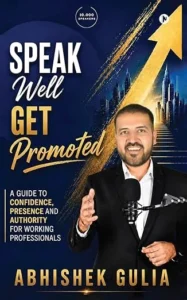
From our founder
Speak Well, Get Promoted
By Abhishek Gulia, founder of 10,000 Speakers
“Every day, in meetings and boardrooms across India, talented professionals are overlooked, not because they lack ability, but because their ideas remain unheard.”
A guide to confidence, presence and authority for working professionals.
The 5 best books for public speaking at work
1. The Art of Public Speaking by Dale Carnegie
Carnegie wrote this book in 1915 with J. Berg Esenwein, long before How to Win Friends and Influence People. The problem it deals with has not changed: you know what to say, and it still comes out flat. It is free to read online.
Best for: your delivery, meaning how you sound. Much of the book is about your voice: pace, pitch, emphasis and pauses. If that is where you want to start, our guide to voice modulation has a 10-minute exercise built on the same ideas.
Try this in your next meeting: Carnegie gives a whole chapter to the pause. So the next time you share a key number in a review, stop for a second before you say it. “This quarter, our costs came down by…” pause “…22 percent.” To the room, the silence says this part matters.
Who can skip it: anyone who wants help with slides, structure or online meetings. Some of the language also feels dated.
2. Resonate by Nancy Duarte
Nancy Duarte’s design firm builds presentations for large companies. In Resonate, she shows the pattern behind talks that actually move people. Her main point is that the audience is the hero of your presentation, and your job is to guide them.
Best for: presentations where you need something from the room: a budget, an approval, a change in how the team works.
Try this in your next meeting: Duarte notices that strong talks keep moving between “what is” and “what could be.” Before your next proposal, write two lines. The first is how things are today (“Our reports take three days to put together”). The second is how they could be (“With this tool, they take three hours”). Open with the first, show the second, and move between them a few times. Then end with a clear ask: what you need from them to get there.
“While explaining to clients or investors I would lose some of the points, and that really made me lose on some deals.”
Pranita Kohli, founder, financial services
Who can skip it: if most of your speaking is quick updates in stand-ups. Many of its examples come from famous speeches and product launches.
3. Talk Like TED by Carmine Gallo
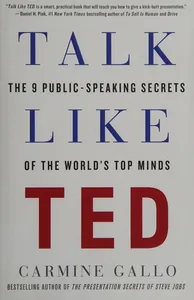
Gallo studied popular TED talks and interviewed the people who gave them, and boiled what he found down to nine habits, including telling stories, teaching the audience something new and keeping talks short. The habits carry over to a quarterly review.
Best for: making a presentation stick, when people nod along during your talk and forget it by lunch.
Try this in your next meeting: Gallo’s rule is that a talk should run 18 minutes at most, because people stop taking things in after that. If you have a 30-minute slot with seniors, plan to speak for 15 and leave the rest for questions. A shorter talk forces you to cut what doesn’t matter, and that is what makes the rest stick. Our guide on how to start a speech shows how to put your main point in the first 30 seconds.
Who can skip it: if your talks are mostly short updates and client calls. The examples come from TED speakers with weeks to rehearse.
4. Confessions of a Public Speaker by Scott Berkun
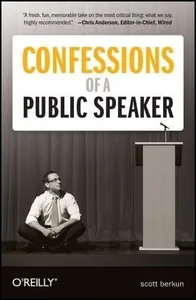
Scott Berkun was a manager at Microsoft before he started speaking for a living. This book is his honest, often funny account of what really happens when you speak, including the talks that went badly and the nerves that never fully go away. It reads like a senior colleague telling you how it really goes.
Best for: nerves, and the moments when something goes wrong in the middle of a presentation. The book makes the fear feel normal rather than something to hide. For what to do in the moment itself, see our guide on how to overcome stage fear.
Try this in your next meeting: Berkun advises against opening with an apology for the projector, the time or how little you prepared. It tells the room to expect less before you have said anything. So skip “Sorry, I didn’t get much time to prepare this” in your next review, and start with your first point.
Who can skip it: if nerves aren’t your problem, much of it will feel like stories rather than steps.
5. Think Faster, Talk Smarter by Matt Abrahams
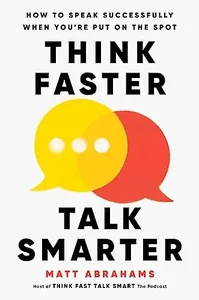
Matt Abrahams teaches strategic communication at Stanford’s business school and hosts the podcast Think Fast, Talk Smart. This 2023 book is about the speaking nobody prepares for: the question in a review, the “any thoughts?” on a client call, the moment your manager turns to you without warning.
Best for: speaking off the cuff, when you have the answer in your head but it comes out scattered because you had no time to plan it.
Try this in your next meeting: Abrahams suggests a simple structure: What? So what? Now what? Start with what is happening (“The client has pushed the launch by two weeks”). Then say why it matters (“That puts our testing window under pressure”). End with what should happen next (“I’d like to move two people onto testing from Monday”). Three short sentences, and you sound prepared. Our guide to impromptu speaking uses a similar shape.
Who can skip it: if most of your speaking is planned presentations, you will get more from Resonate or Talk Like TED.
What can reading these books do for you?
Reading won’t make you a better speaker on its own. Nobody learns to swim from a book. But the right book shows you what to practise, and that is half the work.
Most of us know when a presentation didn’t go well, but we can’t say why. Maybe you rushed the one number that mattered. A good book puts a name to these moments, and once you can name the problem, you can work on it.
The trick is to read slowly and use one idea at a time. Try it in your next stand-up or review, notice what changes, then move to the next. Our guide to improving your public speaking skills turns that into a four-week plan, and it gets easier still with regular practice in front of a real room.
Want to practise what you read with real feedback? Join our ₹249 live session.
Frequently asked questions
Which book should I read first to improve public speaking at work?
It depends on what you struggle with. If nerves are the problem, start with Confessions of a Public Speaker. If you freeze when asked questions without warning, pick Think Faster, Talk Smarter. For pitching ideas to seniors, go with Resonate.
What are the top 5 communication books for working professionals?
For speaking at work, the five on this list cover the main ground: The Art of Public Speaking for delivery, Resonate for persuading, Talk Like TED for making ideas stick, Confessions of a Public Speaker for nerves and Think Faster, Talk Smarter for unplanned moments.
Which book helps with answering unexpected questions in meetings?
Think Faster, Talk Smarter by Matt Abrahams. Its “What? So what? Now what?” structure helps you give a clear answer even when you haven’t prepared.
Is Dale Carnegie’s The Art of Public Speaking still useful today?
Yes, especially for delivery: your voice, pace and pauses. Some of the language feels dated, and it won’t help much with slides or online meetings.
How can I practise what I learn from these books?
Pick one idea and use it in your next stand-up or review. For faster progress, practise where you get real feedback, like a live speaking session.